
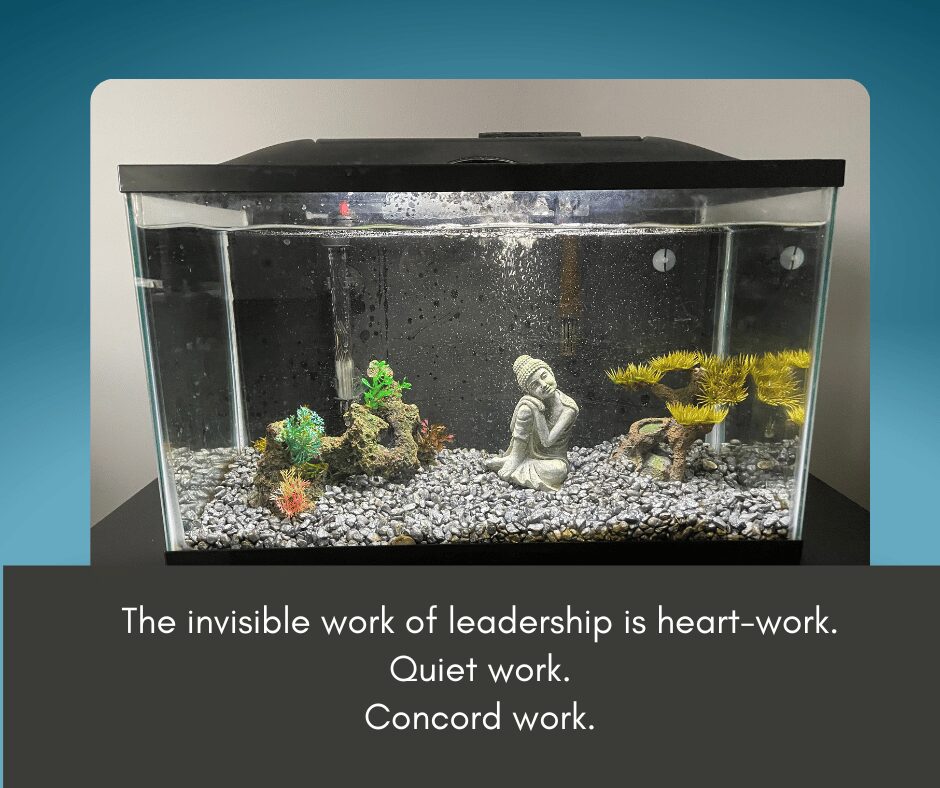
I have an aquarium in my office. Right now, it holds one small fish and one persistent snail. The tank needs a clean and a top-up of water. I know this. And yet… I’ve been enjoying the soft background sound of water dribbling from the filter into the tank. It’s soothing, familiar, a gentle soundtrack to my workday.
But here’s the truth I keep pretending not to know: the longer I enjoy that sound without tending to the tank, the more effort the cleaning will take.
And that has me thinking about the invisible tasks of leadership—the ones that require regular attention, the ones that only become visible when neglected.
The Work No One Sees (But Everyone Feels)
In organizations, teams, and even in our own personal leadership, there is an entire ecosystem of quiet tasks that keep things healthy:
- The check-ins that maintain connection
- The documentation that keeps systems clear
- The boundaries that keep workloads sustainable
- The conversations that prevent misunderstandings
- The reflection that keeps vision aligned
These rarely show up in performance reviews. They’re not glamorous. No one cheers when you clean the filter, reset the expectations, clarify a process, or revisit that conversation you intended to have three weeks ago.
But like the aquarium, neglect accumulates. Small particles cloud the water. A little algae here, a little imbalance there. Nothing catastrophic—until suddenly it is.
Invisible leadership work matters precisely because it is what allows everything else to function smoothly.
The Concord Connection
In my last post, I wrote about what concord means: being “with heart.”
Leading with heart—real, grounded, generous heart—requires attention to the things that don’t usually get applause.
It’s not just big strategic decisions or visionary ideas.
It’s maintaining the environments—emotional, relational, operational—where the people you lead can breathe, thrive, and grow.
The invisible work of leadership is heart-work.
Quiet work.
Concord work.
When the Filter Gets Loud
In my office, the filter’s trickle is a little reminder:
Pay attention while it’s small.
Handle the thing when it’s easy.
Care for the living system before it becomes an urgent repair.
Most leaders know this intuitively.
Many ignore it anyway because the urgent always screams louder than the important.
But a healthy tank—and a healthy team—doesn’t happen by accident.
It happens because someone takes responsibility for the invisible work before it becomes visible.
A Question for Your Week
Where in your leadership ecosystem is the “filter noise” trying to get your attention?
What small task, neglected conversation, overdue clarification, or quiet boundary needs tending now—before the work becomes harder later?
Clean the tank early.
It’s amazing how much clearer everything becomes.


0 Comments